
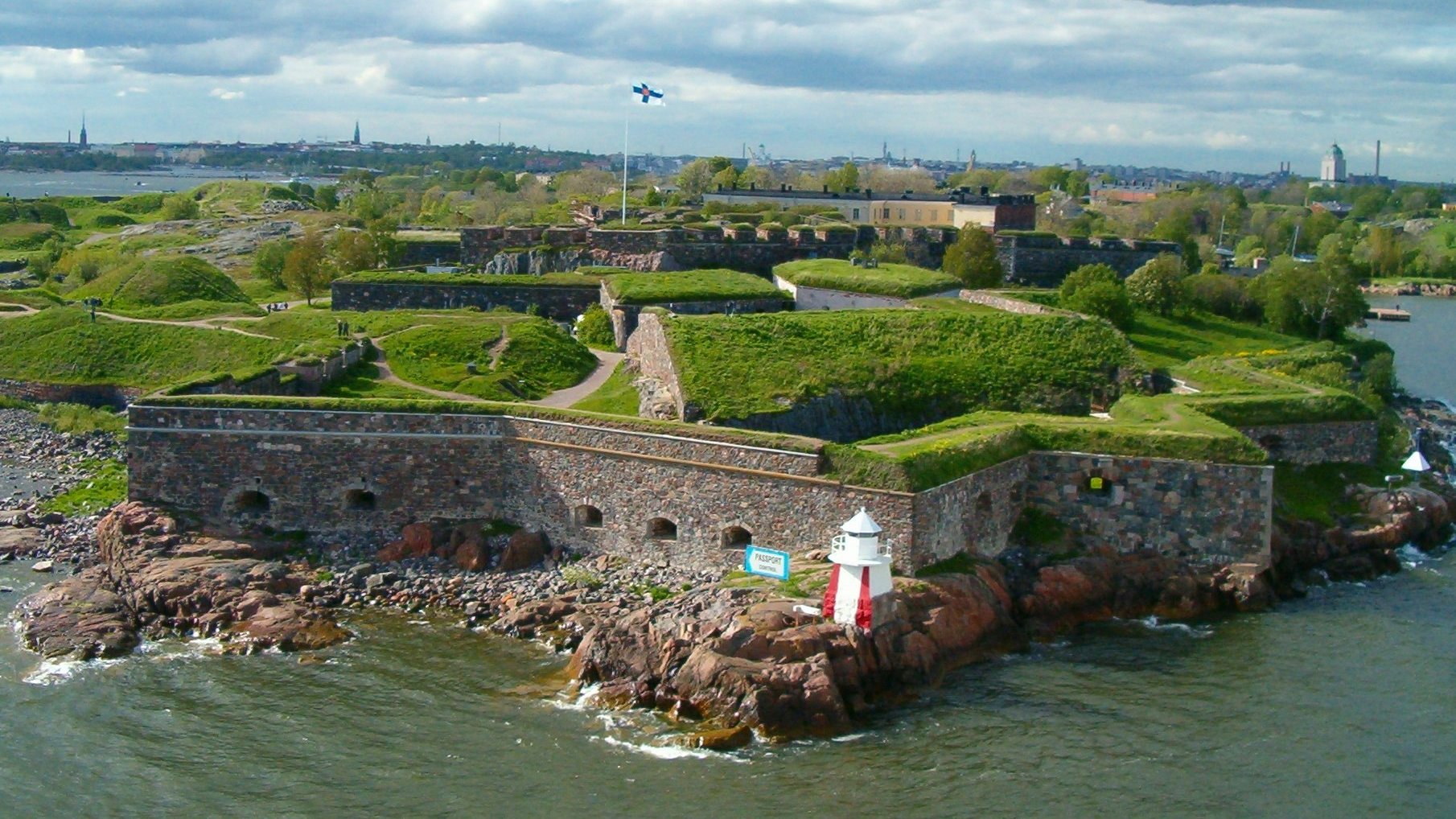
At the mouth of Helsinki’s harbor lies Suomenlinna, a fortress that embodies the Age of Enlightenment’s marriage of rational military planning and architectural grandeur. Built in 1748 under Swedish rule, this maritime fortress was conceived as the “Gibraltar of the North” – a testament to both military pragmatism and artistic vision.
Historical Context
When Swedish Field Marshal Augustin Ehrensvärd laid the first stones of Sveaborg (Suomenlinna’s Swedish name), he wasn’t just building a fortress – he was creating a self-sufficient maritime city. The project reflected the period’s fascination with ideal societies, combining military precision with civilian life in a unique Baltic experiment.
Architectural Innovation
The fortress showcases several revolutionary features:
• Double-bastioned fortification system
• Integrated dockyard (still operational)
• Self-sufficient closed society design
• Innovative use of local granite
The massive King’s Gate, carved from local granite, stands as the fortress’s ceremonial entrance. Its baroque detailing reflects the dual nature of Suomenlinna – both brutally practical and aesthetically ambitious.
Strategic Significance
Suomenlinna’s story mirrors the Baltic’s shifting power dynamics:
1748-1808: Swedish bastion
1808-1918: Russian expansion
1918-present: Independent Finland
The fortress never fulfilled its original military purpose, yet paradoxically achieved something more lasting – becoming a living monument to Nordic maritime heritage.
Essential Sights:
1. Great Courtyard (Suuri linnanpiha)
The administrative heart of the fortress, showcasing perfect symmetry and period architecture.
2. Ehrensvärd’s Tomb
The final resting place of the fortress’s visionary creator, designed by King Gustav III himself.
3. Vesikko Submarine
A rare surviving example of Finland’s WWII submarine fleet, offering insights into 20th-century naval warfare.
4. Artillery Bay (Tykistölahti)
Where modern shipbuilding meets 18th-century marine technology.
Practical:
Access:
• HSL ferry from Market Square (Kauppatori)
• Year-round service
• Part of Helsinki’s public transport network
Optimal Visiting Strategy:
Morning: Start with the main museum for context
Midday: Explore the ramparts and fortifications
Afternoon: Visit the church and smaller museums
Evening: Artillery Bay for sunset views
Seasonal Notes:
• Summer brings midnight sun and crowded ferries
• Winter offers stark beauty and solitude
• Spring and autumn provide photographer’s light
Cultural Significance Today:
Suomenlinna remains a living community, home to around 800 residents. This continuous habitation helps preserve the fortress’s authentic character, making it more than just a museum piece.
The fortress serves as a unique lens through which to view Nordic history – from Swedish grandeur through Russian expansion to Finnish independence. Each stone and bastion tells part of this complex narrative.
For the Discerning Visitor:
• Consider joining a specialized architectural tour
• Visit the military history archive (by appointment)
• Explore the restored 18th-century naval officers’ quarters
• Study the innovative dry dock system
Beyond the Standard Visit:
• Track the influence of French military architecture
• Observe the integration of natural topography into defense
• Study the evolution of European fortification techniques
• Examine the restoration philosophy in practice
This is more than just another fortress – it’s a preserved moment in European military architecture, a testament to Enlightenment ideals, and a living community. Understanding Suomenlinna means understanding the Baltic world that shaped modern Northern Europe.

